

Content strategy
or, how I create order out of content chaos

Style guides
WestJet digital style guide
This project bridged the gaps between the airline’s marketing and operational/regulatory content teams to better align on content standards.
Discover. In my content audit of WestJet.com, I discovered inconsistent, unclear, and poorly designed content creating issues for users. Themes included excessive hidden content (tabs, accordions, deep pages), inconsistent application of voice and tone guidelines, and poor organic discoverability for content.
I did a gap analysis on the existing writing guidelines to find what was missing for digital content principles. Plus, I interviewed content contributors from different teams to learn about their challenges when creating content for the web.

Define. I found that content contributors had low knowledge about the specifics of writing for the web. There was a general lack of web accessibility and SEO understanding, and little knowledge of user experience and behavioural science principles. I found that content writers from business lines were unfamiliar with the brand guidelines, and while some were excellent writers in terms of grammar, they weren’t experienced in readability, plain language, and usability heuristics.
We needed to create a digital content style guide that would be easy to follow for all content contributors. This would ensure all published content was consistent, purposeful, and met SEO and a11y standards.
Develop. I categorized the web content and created templates and principles based on its purpose — whether it was persuasive, informative, or instructional. I developed guidelines for inclusive writing, plain language and readability, and documented decisions for details like date and time formats, sentence vs. title case, and what publishing style guide to follow for punctuation and spelling. It also defined when to use the brand guidelines (for voice) and when to use the digital guidelines (for style).
Deliver. Collaborating with front-end developers, we made elements in the page templates mandatory, including structured headings, image alt-text, button and link labels, and meta data for search. Standardizing the page templates by purpose helped the teams better plan and scale their content. I also developed and delivered WCAG and SEO training for content creators.
To house the standards, I created an intranet site with a message board so users could ask questions or request additions to the guidelines. To keep the audience engaged, I started a monthly newsletter, featuring a blog post about a web writing concept. It featured topics like:
- Three reasons “click here” has no business on your website
- “People don’t read” and the myth of inattention
- Is text on an image ever okay?
- When bad jargon ruins good writing
Reflections. This exercise in style guide creation and adoption raised the profile of the content strategy team and gave us an avenue to demonstrate our expertise. Soon, I started a community of practice for content creators on different teams (digital, marketing, brand, public relations, and social media) and we collectively maintained the styleguide, aligned on terminology, and kept each other informed about our work. The commercial airline industry is very complex, and requires high-trust from customers. This process enabled distributed teams to align on a standard, preventing low-quality content that could damage the company’s reputation and erode customer confidence.
Chatbot personas

H&R Bot
This project addressed the strategy, implementation, and standards for the H&R Block Canada chatbot, a rules-based bot powered by Zendesk.
The scene. In 2022, H&R Block Canada implemented a chatbot to replace the call centre as the first-line of contact for users of their DIY tax software. The first chatbot iteration was extremely limited, with only two topics available — paid technical help and paid tax help.
Discover. As part of a larger help content strategy project, I audited the end-to-end DIY experience including chat, help centre, and in-context help. There was a large corpus of conversation queries, so I analyzed and categorized the topics customers wanted to use the chatbot to support with. There was also a lot of customer feedback to gather sentiment analysis about the chatbot.
Define. I need to create the chatbot strategy from the ground up, determining the topic coverage, the hand-offs to live agents, the chatbot persona, and the writing standards for future content contributors.
Develop. One of my favourite workshops to host is the chatbot personality canvas. It’s a framework I’ve adapted from the book Conversations with Things by Diana Deibel and Rebecca Evanhoe. I find the practice of getting stakeholders in a room and discussing different facets of the bots functions, priorities, and persona to be extremely productive. We came to a consensus on:
- Interaction goals. What does a successful interaction look like? How does it support business goals?
- Level of personification and it’s power relationship to the user. Is it trying to be human-like? Does it have a name? Is it self-referential? Is it an advisor or a servant?
- Characteristics and key behaviours. What does it do and how does it act while doing it?
- Tone. What does it feel like to interact with the bot?
- Scenarios. How does it respond when the topic intent is a low confidence match? When it gives wrong information? Does it apologize?
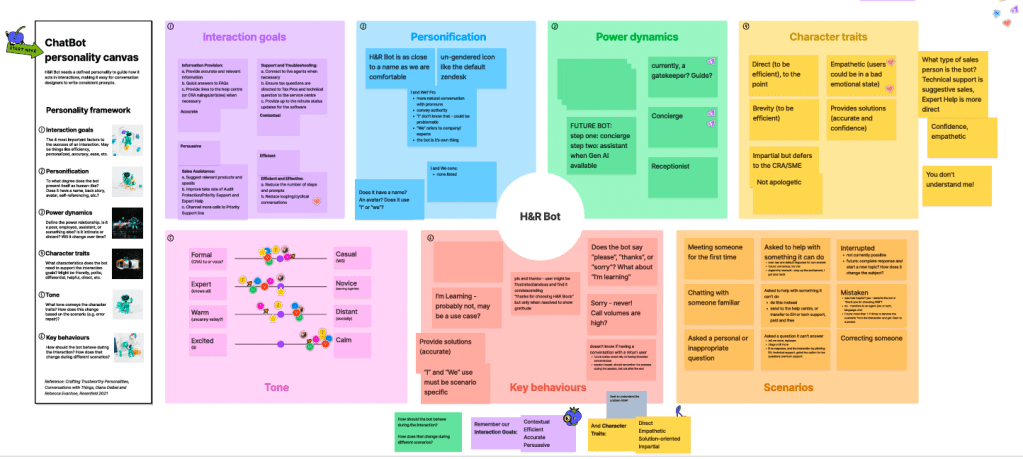
Deliver. Out of the decisions made in the workshops, I created and socialized the H&R Bot writing guide. It outlines the principles for a successful conversation with the bot: Contextual, Efficient, Accurate, and Persuasive. The H&R Bot is a concierge, directing users to the appropriate workflows quickly, suggests add-ons when helpful, and refers to subject matter experts like the help centre, Tax Experts, and the CRA/Revenu Québec.
The brand’s tone in the writing style guide is knowledgeable, empathic, lighthearted, and clever, so I adapted those characteristics to the context of a chatbot. I’m of the opinion that corporate support chatbots should not attempt to be human-like in interactions, it needs to be clear the user is interacting with a machine. So while the bot can be written as knowledgeable, traits like empathic, lighthearted, and clever are human so we didn’t attempt to replicate them.
The guide includes writing conventions for tone, grammar, mechanics, and vocabulary. I also included tips to design effective conversations, such as when to use implicit or explicit confirmations, how to use transition words when giving instructions, how to vary error repair messages, and where in the prompt to put the reponse cue.
Reflections. When hosting the bot persona development worshops, I had representatives from product design, content design, technical writing, product management, retail operations and client support to get the most robust input I could. Involving stakeholders from many functions across the digital and business teams helped me get alignment and buy-in to make the changes I recommended, and created a sense of shared ownership over the outcomes.
 KL Portfolio