
When does a feature get a name?
Summary.
I led content design and strategy for a feature to enable users to request money from multiple contacts at once.
Role.
Content strategy and user research
Skills.
Research
Facilitation
Information architecture
Plain language
Team.
Senior Content Designer (me!)
Lead Product Manager
Product Designer
Engineering Lead
At Scotiabank, we designed a feature to enable users to calculate and request money from their contacts for shared expenses. More Interac e-Transfer requests mean more deposits, aligning with the bank’s strategic priorities. When this feature is released, we anticipate a 15% increase in requests and a projected $25 million in deposits coming into the bank.
I led content design and strategy, collaborating with a product owner and designer to design and test iterations of this feature with our target audience. I researched, wrote, tested and iterated on the content hierarchy, labelling, and navigation, so it was simple to select contacts and calculate amounts to request from them.
Through usability testing, we learned that users found the tasks easiest to complete when I used descriptive language instead of naming the feature. They were far more confident and able to find and complete the tasks with ease when we talked about “requesting money from a group” vs. “Split Payments.”
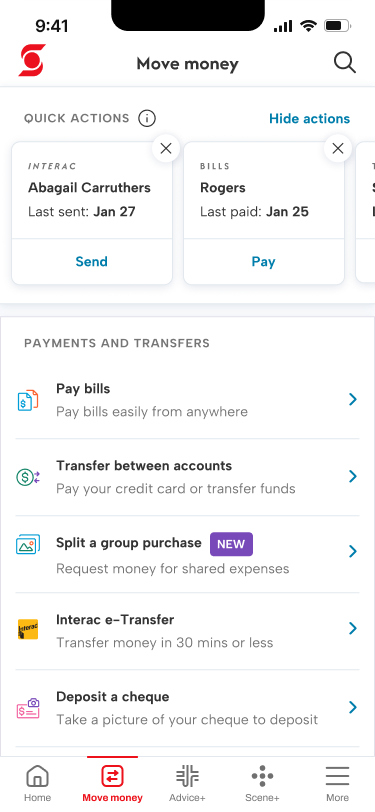
Entry point.
A “new” badge highlights the new feature on the move money landing page.
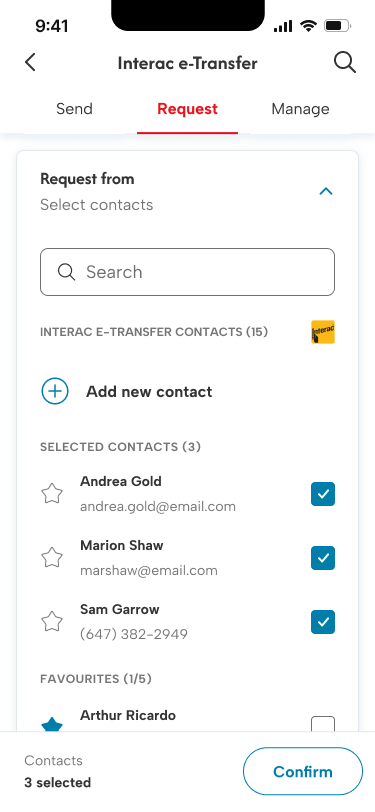
Select the contacts.
The user can select from their existing contacts or add a new one-time contact.
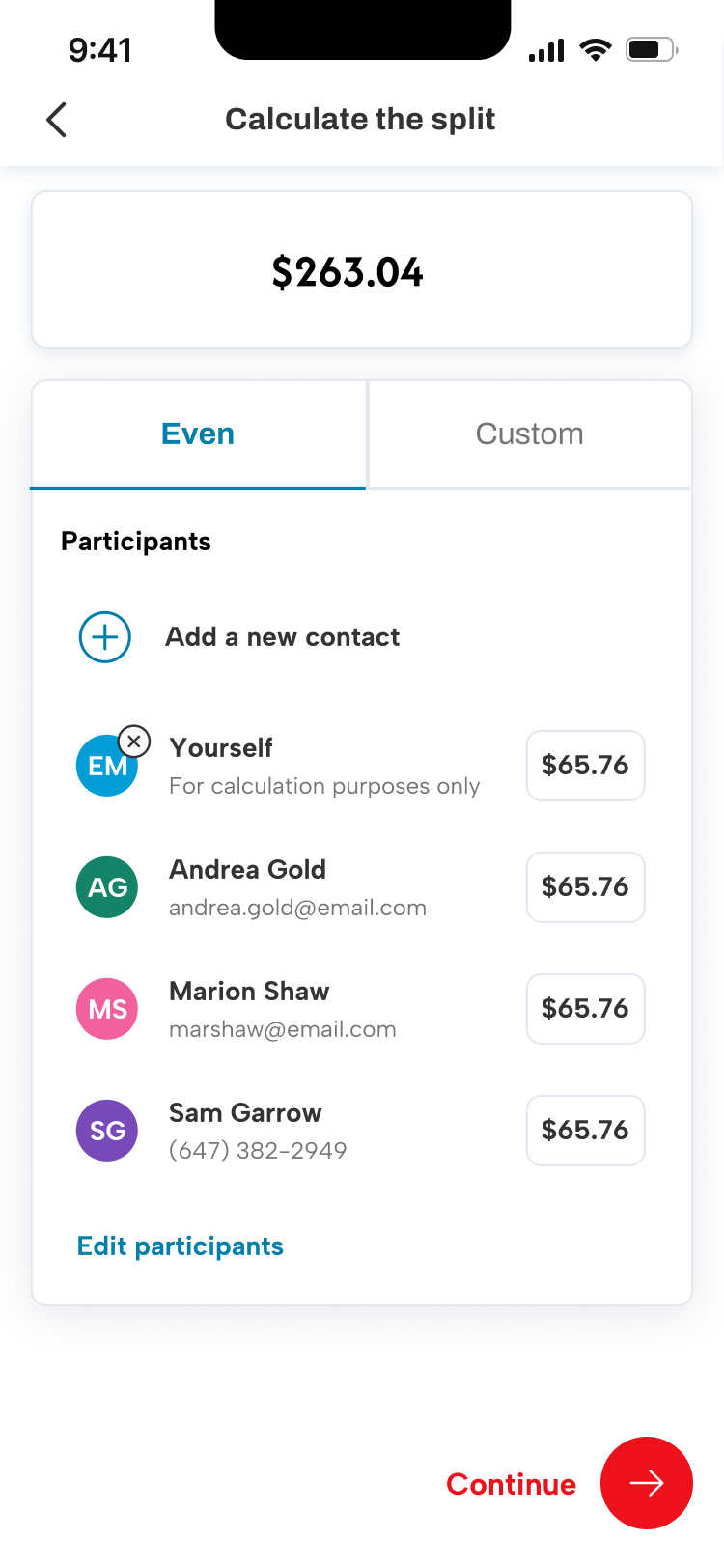
Calculate the split.
The user can split the total evenly or input amounts to request from each contact.
In my experience, named features are more complex to write about, so it made sense that descriptive language improved the feature’s usability. Users want to bank without needing to learn new vocab — they don’t want to engage with their banking app, they want to do a task and get on with their lives. As a content designer, my job is to advocate for users and build customer-centric products, and by avoiding proper noun town, I was able to do that.
 KL Portfolio